
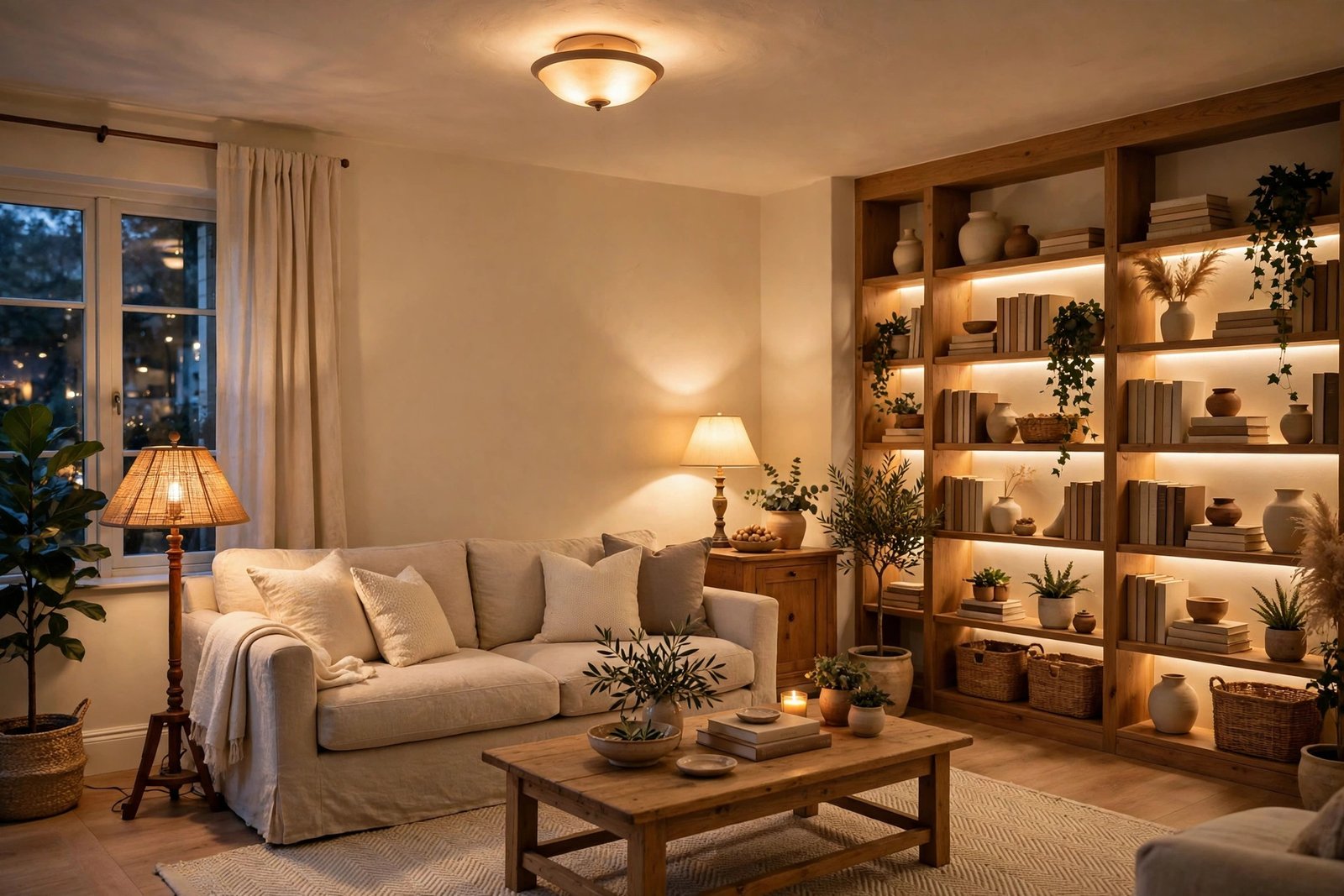
Walk into a living room lit by a single ceiling fixture and you can feel what is wrong before you can name it. The middle of the room is bright, the corners fall away into shadow, faces look washed out, and the sofa — the place you are actually meant to relax — sits under a pool of glare. The room has only one kind of light, doing one job, from one direction, and that is why it feels flat.
Layered lighting is the fix, and it is less about buying more lamps than about giving each part of the room the kind of light it needs. A well-lit living room uses three layers working together: ambient light for general brightness, task light for the things you actually do, and accent light for warmth and character. Once you understand what each layer does, you can build a room that feels comfortable in the afternoon and in the evening, without rewiring anything.
Ambient Lighting: The Base Layer
Ambient light is the general, overall light that lets you move around a room safely and see everything in it. In most living rooms it comes from a ceiling fixture, a chandelier, a flush mount, or recessed downlights. Its job is not to be interesting. Its job is to be even. If your ambient layer is working, you can walk in with an armful of laundry, find the remote, and greet someone at the door without thinking about the light at all. The trouble starts when ambient light is the only light, because a single overhead fixture throws light straight down, leaving the seating area, the shelves and the corners dim. Spread the base layer out instead: a central fixture on a dimmer, plus a floor lamp near the seating or a pair of wall lights, kept modest enough to feel like daylight on a cloudy afternoon rather than a showroom.
Task Lighting: Light Where You Actually Use It
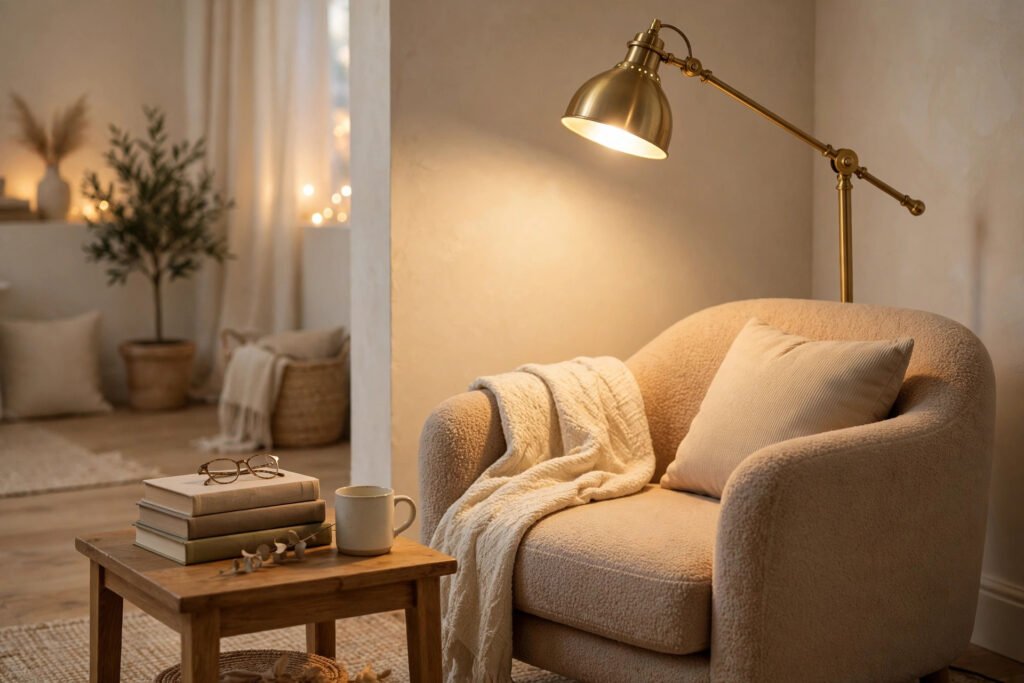
Task lighting is focused, brighter light aimed at a specific activity: reading, knitting, playing a board game, or working on a laptop for an hour. It sits close to where the work happens, so it can be bright exactly where you need it without flooding the whole room. The classic example is a floor lamp with an adjustable arm beside the sofa, or a table lamp on the side table next to your favourite chair.
Place task lights at about shoulder height when you are seated, and slightly behind or beside you rather than directly in front of you, so the light falls on the page or the project instead of into your eyes. If you already have a corner for books, treat it properly — a dedicated lamp turns a chair into a destination, as these cozy reading nook ideas show — instead of leaving the reader to borrow light from the ceiling.
Accent Lighting: The Layer That Makes It Feel Finished
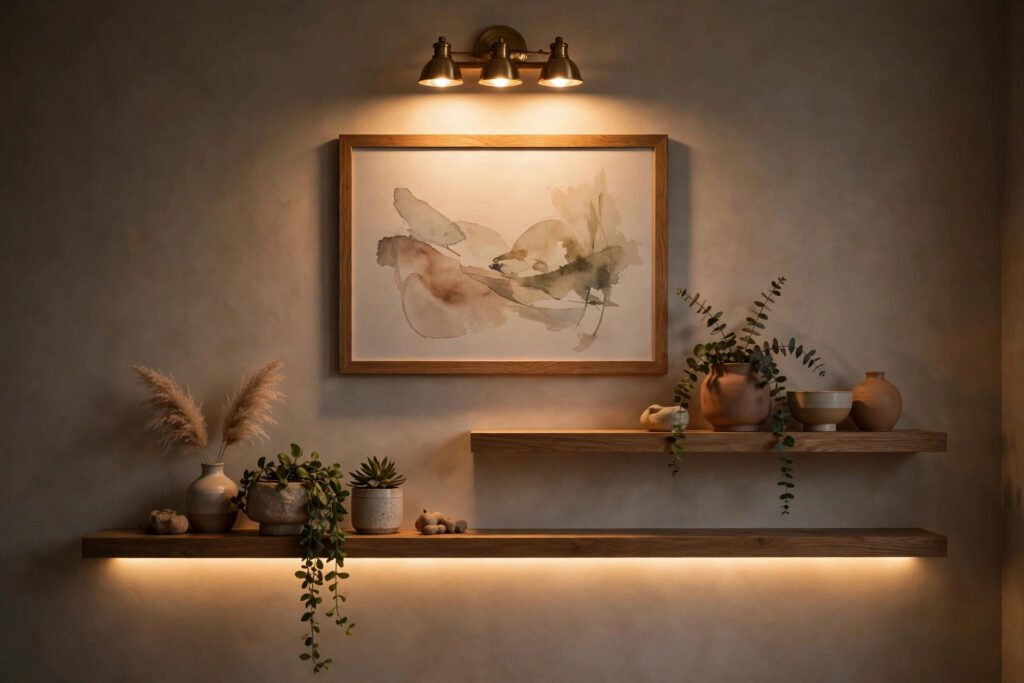
Accent lighting is the quietest of the three layers, and it is the one that makes a room feel finished rather than merely lit. It is the small picture light over a framed print, the warm glow inside a bookshelf, a slim uplight behind a large plant, or candles on the mantel. Accent light is usually only about three times as bright as the surrounding ambient light — enough to draw the eye, never enough to compete with it.
Use it to point at the things you love about the room: art, a textured wall, a collection on a shelf, or the soft, earthy palette you have chosen for the walls. A low, warm wash of light can make even a simple colour scheme feel deliberate and calm, which is why it works so well with muted, natural palettes like the mushroom tones many living rooms are using now.
Getting the Colour Right: 2700K to 3000K
Colour temperature, measured in kelvin (K), matters more than most people expect. For a living room, stay in the warm-white range of 2700K to 3000K. At 2700K the light is soft and candle-like, perfect for relaxing in the evening; at 3000K it is a touch crisper, which suits rooms that also do daytime work. Avoid the cool, bluish light of 4000K to 5000K bulbs, sometimes sold as “daylight.” That light is fine for a garage, but in a living room it makes skin look pale, wood look grey, and the whole space feel clinical.
Consistency matters just as much. If the ceiling fixture is 2700K, the floor lamp is 4000K and the shelf light is 3000K, the room will feel subtly wrong even if you cannot say why, so check the kelvin rating on every bulb and match your layers. Dimmers help enormously too: they let one set of bulbs serve two moods, full brightness for cleaning or a family game night and a low, warm glow for a film or a quiet conversation. If your ceiling fixture is not on a dimmer, that is the single cheapest upgrade worth making.
Common Mistakes to Avoid
The most common mistake is relying on the overhead light alone. Others are going too bright — a living room is not an office — mixing colour temperatures, and placing lamps at the wrong height. A table lamp that is too tall throws light into your eyes, while a floor lamp that is too short leaves the book in shadow. Finally, keep the accent layer quiet. Accent light should whisper; if your picture light is the brightest thing in the room, turn it down.
A Simple Plan for a Real Living Room
If your living room currently has one ceiling light and nothing else, build the layers in this order, using a typical sofa, armchair and television arrangement as the example.
- Start with the ambient layer. Put the ceiling fixture on a dimmer, or swap in a warm 2700K to 3000K bulb, and add one floor lamp near the seating.
- Add task light where you sit: a floor lamp beside the sofa and a table lamp beside the armchair, both at about shoulder height when seated.
- Add one accent. Choose a single focal point — a picture, a shelf, or a plant — and light it with a small, warm accent light.
- Match the colour temperature. Check every bulb and replace any that fall outside the 2700K to 3000K range.
- Test it at night. Sit in each seat after dark and read a page, watch the television, and have a conversation, adjusting lamp positions until no seat is in glare or shadow.
- Live with it for a week before buying anything else. You will quickly learn which layer is missing, and you will buy one lamp instead of three.
Conclusion
A living room does not need more light. It needs the right kinds of light, in the right places, at the right warmth. Ambient light gives you a safe, even base; task light lets you read, work and play without straining; accent light gives the room its personality. Keep the bulbs between 2700K and 3000K, put the main lights on dimmers, and build the layers one at a time.